Wednesday, March 9, 2016

On Bra Burning and Being Human

I still feel a little uncomfortable when I describe myself as a feminist. Growing up, “feminist” always had a negative connotation—feminists were those angry women who protested being left out of a men’s only golf club or the crazy women that asserted their liberation by burning their bras and sleeping around.

After my undergrad, I taught elementary school, and my friends all went to grad school. And one by one, they all became feminists. They saw things they’d never seen before and became upset about things that I had never thought of as issues. I didn't get it, and honestly I was a little worried that I'd become an angry feminist myself when I decided to get my master's degree.

During my first semester I took IPT 564 Instructional Design. My male partner and I created an instructional product for our "client," a professor from a different department. In the middle of the semester we went to present what we had so far to the professor. We got his feedback, answered his questions, and came back to the "grad lab" where all the IPT students hang out. I didn't even know anything out of the ordinary had happened until Eric asked me, "Did that bother you?" "What?" I asked. "That he only talked to me," he said. I thought back. The professor had only made eye contact with Eric and only asked him questions, even though I had done most of the designing to that point and was the one who could answer his questions. I realized then, that I could face discrimination in the work place and needed to be prepared. That was the beginning of my feminism.

I'm not about to burn my bras. I'm not angry. I'm not crazy. This is what my feminism looks like:

I ask for the wage I think I'm worth, even though I'd rather crawl out of my skin.

I am independent, but there is a place and a role for a man by my side.

I do not think that women and men are the same but I do think they are equally important. Both valued. Both needing a champion when trampled upon.

I reject the pedestal that sometimes women are placed on. I cringe when I hear a church leader say off-handedly, “we all know that one sister missionary is twice as effective as three elders,” because I believe that false generalization hurts both men and women.

I hurt for the boys who are told they need to stop crying, suck it up, and be a man, and thus learn shut off a part of themselves.

I constantly remind myself that I am working out because I love my body and I want to be healthy and strong—not to shame my body into submission so I can be sexy.

I declare that my value to society is created by what I contribute—not by how attractive I am to a man.

I revere fatherhood and motherhood. I assert the dignity of being a parent, aunt, advocate, or caregiver.

The term “feminist” seems inadequate--what I feel is more inclusive than that. I want to reclaim the term “humanist” so that rather than meaning someone who asserts human logic over God, it means someone who feels empathy and connection with all humans. I am pro-human—not just pro-woman. I identify with being a human first, and with being a woman second. Just like I identify with being a citizen of the world first, and a citizen of the United States second. We are all connected.

Thus I collect donations for Somali refugees being resettled into Salt Lake. I stay present as I watch a sobering documentary about child sex slavery. I keep up with what the "so-called Islamic State" (I love that BBC news called ISIS that) is doing, even though I can't do anything about it. I listen to my gay friend wrestle with God and church and feel his frustration and confusion as if it were my own. And I speak up when I see sexist memes on International Women's Day.

Friday, September 20, 2013

That I Might "Not Shrink"

I've been going through a rough time lately that could be made a lot easier if I moved.  Living where I do, the issue is always in my face, and the scab on my heart is picked at daily.  It's kind of hard to heal (understatement of the year).

I counsel with the Lord in everything that's important to me, so naturally I've talked with Him about this.  He has encouraged me to stay.  I feel that I'm not supposed to run away (as I have with similar situations in the past).  I'm supposed to face this head on.  I'm not supposed to "shrink."

Elder Bednar, one of the twelve apostles, spoke on this subject in March.  The quotes I use come from his talk.  Shrinking means to "retreat or recoil," to step back from the hard thing we are facing.  The term comes from modern day scripture, when Christ speaks about his atoning sacrifice.  It is the only scripture I know of where we get to hear His perspective on the suffering He endured:

“Therefore I command you to repent—repent, lest I smite you by the rod of my mouth, and by my wrath, and by my anger, and your sufferings be sore—how sore you know not, how exquisite you know not, yea, how hard to bear you know not.
“For behold, I, God, have suffered these things for all, that they might not suffer if they would repent;
“But if they would not repent they must suffer even as I;
“Which suffering caused myself, even God, the greatest of all, to tremble because of pain, and to bleed at every pore, and to suffer both body and spirit—and would that I might not drink the bitter cup, and shrink—
“Nevertheless, glory be to the Father, and I partook and finished my preparations unto the children of men” (D&C19:15–19).
Jesus wanted to bravely face the hardest thing He could ever do.  He didn't want to "shrink" from the assignment His Father had given Him.  Elder Bednar quotes Elder Maxwell in saying, "Moreover, partaking of a bitter cup without becoming bitter is likewise part of the emulation of Jesus."

I, too, want to face this without shrinking.  I want to drink this bitter cup without becoming bitter.  The temptation occasionally comes to vilify the object of my pain, to emphasize his negative attributes and victimize myself.  But I reject those thoughts.  I know they aren't true, and I know they come from the Father of Lies.  I choose love.  I choose to continue to love.

Elder Bednar continues his remarks by quoting Elder Orson F. Whitney about the purpose of trials.
“No pain that we suffer, no trial that we experience is wasted. It ministers to our education, to the development of such qualities as patience, faith, fortitude and humility. All that we suffer and all that we endure, especially when we endure patiently, builds up our characters, purifies our hearts, expands our souls, and makes us more tender and charitable, more worthy to be called the children of God … and it is through sorrow and suffering, toil and tribulation, that we gain the education that we come here to acquire” 

This quote gives purpose to my suffering and gives me strength to endure well.  I am turning to Christ and He gives me grace to confront this head on.  My heart is softening, and I am becoming a little more like my Lord and Savior.  Though I never would have chosen it, I am grateful to have this experience and learn these lessons.

Sunday, September 9, 2012

The Righteousness Cycle

Today in Sunday School we were discussing "the pride cycle."  This cycle is seen repeatedly in the Book of Mormon.  The people are righteous, so the Lord blesses and prospers them.  They set their hearts on riches and get prideful, and stop being so righteous--they put themselves into classes, look down on others, and stop taking care of the poor.  All of a sudden they abandon the Church of Christ and start building up churches to get gain.  After a period of wickedness, they have negative consequences.  War, perhaps.  The Lord leaves them to their own strength, which of course is weak, and they are compelled to be humble.  They reach out to God in sackcloth and ashes, lamenting the fact that they didn't listen to the prophets.  After sufficient repentance, the Lord forgives them, they keep the commandments, and live righteously again.  It happens time and time again.

We began discussing how to just stay at the top of the cycle--being righteous and being blessed by God.  In my personal study this afternoon I thought more about the subject.  What if the righteousness cycle went like this?

Being righteous--continually being stirred up in remembrance--humbling ourselves--repentance
Then it loops around in a cycle.

Another theme in the Book of Mormon is the idea of remembering.  That we need to remember the Lord in order to have his Spirit to be with us.  That we need to remember what He did for our forefathers and be grateful.  So we need to be continually stirred up in remembrance, by attending church, reading our scriptures, writing/rereading our journals (to remember the great things the Lord has done for us!), and having gospel conversations.  This might remind us of something we should do or something we should stop doing, in order to improve and become closer to Christ.

This will naturally lead us to humbling ourselves.  Instead of waiting for God to compel us to be humble, if we are constantly immersed in remembering the gospel, we will naturally find things that humble us.

Once humble, we can approach God and ask for His grace.  We can repent of our sins and ask for increased virtue.

And thus we increase in righteousness.

Saturday, May 19, 2012

6 Love Languages?

The book "The Five Love Languages" is widely accepted.  I read the speedy version of the book, took an online quiz, and had several discussions on the matter with friends.  I discovered through the quiz that my primary love language is service, following by physical touch, then quality time.  Words of affirmation mattered a little, and gifts didn't even register.  I accepted this as truth and analyzed my relationships through this lens.

Then today I was reflecting on what makes me feel loved.  When a person walks (or runs) a little slower than he would normally in order to stay by my side.  When someone does a favor for me.  When someone remembers and asks about something that's going on in my life.  When someone makes something for me for my birthday.  When someone gives up doing another activity in order to spend time with me.  When someone calls me out of the blue just to see how I'm doing, etc.  These things could fall under the categories of service, quality time, and gifts, but the common element between them is sacrifice.  That is what makes me feel loved.  When I am important enough for someone to sacrifice for, then I feel safe, secure, and loved.

And I have noticed that sacrifice is how I show love as well.  When my sister was sad and wanted me to make a treat, I'd do it, even though I had piles of homework.  When she was devastated over the loss of a flip flop, I went to the mall and bought her new ones with my own money.  When a friend needs a ride to the airport and calls me last minute, I drop what I'm doing and go.  When it's someone's birthday, I love to figure out a thoughtful gift to give.  When someone needs to talk, or needs a back rub, or needs some hot soup, it makes me feel fulfilled to sacrifice for them and fulfill that need.  Sacrifice, to me, means love. 

Sunday, May 13, 2012

What is LOVE?

The concept of love is of utmost importance.  It is the most important human feeling and motivating power.  It defines a worthwhile life.  Love is the basis of the first and second great commandments.  We all want to love and be loved.  Yet, despite knowing its importance, we struggle to know what it is.

Seemingly from the beginning of time, people have theorized about love.  The Greeks had four different words for love: storge (affection), philia (friendship), eros (romance), and agape (unconditional love).  Some define different types of love based on relationships: parent-child, friend-friend, man-God, lover-lover, etc.  In a psychology textbook I recently consulted, it proclaimed that theorists almost universally agree that love is divided into "types."

Jesus teaches us to love.  The first great commandment is to love God and the second is to love our fellowmen as we love ourselves.  The New Testament and the Book of Mormon teach us that we need charity, the pure love of Christ, to be saved.  Yet, we often separate this idea of Christian love (love of God and godly love for others) from our ideas about loving our friends, family, and significant others.  But the question I asked my self and that I ask you is, are they really different?

Is the love that I feel for a boy different than the love I feel for my mom?  Is the love I feel for my best friend different than the love the Savior admonishes us to have for all men?  Is the love I will one day feel for my children different than the love I feel for Christ?  Is love different when it is had in different relationships?  I argue that it is not.  Other things may be stirred into the mix (romantic love combines attraction and commitment, for example), but the love itself is the same.

So what is love?  How is it characterized?  Recognized?  Grown?

I submit that instead of types of love, there are levels.

On a basic level, love is an emotion of attachment and affection.  I feel this kind of love for my "circumstantial friends."  I like being around them; they make me happy.  I also feel this for extended family members that I don't see very often (being family, there is an added measure of commitment that isn't there with circumstantial friends, but it's the same level of love).

When love is complete, or perfect, it is the type of love we associate with the word charity.  You love the person for who they are, not what they do, and thus your love is an unchangeable fact.  You see the best in the person.  You see their potential and believe in their capacity to change and improve, thus enabling them to do so.  You give them the benefit of the doubt and forgive them easily.  You seek their comfort and well-being above your own, putting their wants and needs above yours.  In doing so you feel no ill will or resentment, only sincerity.

Marvin J. Ashton said, “Perhaps the greatest charity comes when we are kind to each other, when we don’t judge or categorize someone else, when we simply give each other the benefit of the doubt or remain quiet. Charity is accepting someone’s differences, weaknesses, and shortcomings; having patience with someone who has let us down; or resisting the impulse to become offended when someone doesn’t handle something the way we might have hoped. Charity is refusing to take advantage of another’s weakness and being willing to forgive someone who has hurt us. Charity is expecting the best of each other.”

In between the basic and complete loves are countless levels of increasing emotion, building to reach the point of completeness.  There is an increase of mercy, compassion, service, gratitude, kindness, and understanding.

My good friend told me about a theory she read about that makes sense to me.  In this theory, the levels of love are called: identification, consummation, and consubstantiation.  Basically, the more you understand/know the person, the more you identify with them, and the more you love them (eventually ending at becoming "one").  The level at which you understand someone, have empathy for them, and put yourself in their shoes is the level at which you love them.  I've noticed that in my own life.  In high school I realized that when I didn't like people or they rubbed me the wrong way, it was because I didn't know them well enough.  Without fail, as I came to know those people better, I understood why they did things the way the did, and grew to love them.  The better you understand someone, the more you naturally love them.

For me, this shed an incredible light on Christ's love.  I believe that in the Garden of Gethsemane, Christ experienced each of our lives.  He felt our guilt, pain, sickness, sorrows, anxieties, and temptations.  He did this, as the Book of Mormon prophet Alma teaches, "that his bowels may be filled with mercy according to the flesh, that he might know according to the flesh how to succor his people according to their infirmities" (Alma 7:12).  Christ has perfect empathy for us and understands us perfectly, thus he can love us perfectly.  The atonement of Jesus Christ gave him a complete level of identification with us.  Because he understands me so perfectly he loves me completely.  I will be able to love Christ in return as I increase my level of identification with him.  The more I keep his commandments, feed his sheep, and build his kingdom, the more I will understand and love him.

Thus, my conclusions are as follows: there is one love instead of differing types of love, love is felt in varying degrees, and the more we understand/identify with someone the more we love them.  I also think that love is grown through sacrifice and service.  The more we give of ourselves, the more attached we feel and the more compassion we have.

Sunday, March 4, 2012

Living Deliberately

I've been thinking a lot about the concept of living deliberately. It's a phrase that a friend of mine used a few years ago, and I've adopted it as part of my general philosophy of life. I believe in living on purpose!

Ralph Waldo Emerson once said, "The unexamined life is not worth living."

In order to live deliberately, you have to examine your life. You have to look at things from the outside looking in, analyze them for what they are, and decide how you actually want things to be.

A lot of people simply live life. They go with the flow. They do what they were taught or what the people around them are doing. Never questioning. Never questioning if the status quo is the best way. And that's my tendency too, but as I get older, I've questioned more.

Part of it is my nature as a planner. I've been a planner ever since I was a kid. I remember sitting in the car on a long car ride as a 14 year old, and writing a list of approved toys for my future children. I saw things around me that I didn't like (especially those brightly colored alien-looking toys that make annoying noises), and I wanted to make sure that when I grew up I did things differently. My ideas have changed since then, but the principle is the same: I think about how I want things to be/how I think they should be, and I make plans. I do this in my occupation all the time, and I do it in my personal life. I am always reevaluating and making goals. I make things happen. I find great satisfaction and fulfillment in living deliberately. I am getting what I want to out of life. :)

Monday, October 31, 2011

Peace in this World

In Doctrine and Covenants 59:23 we learn that, "he who doeth the works of righteousness shall receive his reward, even peace in this world, and eternal life in the world to come."

In the Guide to the Scriptures, under "Rest" we learn that rest is "the enjoyment of peace and freedom from worry and turmoil. The Lord has promised such rest to his faithful followers during this life."

In John 14:27, the Savior consoles, "Peace I leave with you, my peace I give unto you: not as the world giveth, give I unto you. Let not your heart be troubled, neither let it be afraid."

If we follow the Savior, we are entitled to feel peace. Sometimes that peace does not come automatically to me--I live a very busy life--but without fail, every time I have prayed to feel peace, it has come. That is a prayer that has always been answered immediately.

I find such reassurance that as followers of the Lord Jesus Christ, we are promised freedom from "worry and turmoil"--how cool is that? I wonder how often we draw upon this promise. I know that I indulge in feelings of worry and turmoil too often. Instead of looking heavenward, I look at my earthly situation and feel worried or stressed about various things. The Savior doesn't want me to worry. He wants me to exercise my faith in Him, and He wants to console me in my worries and fears. He wants me to look toward the future with confidence and hope. This is my privilege, if I but ask for it: peace in this world.

Thursday, December 23, 2010

A Glimpse at Bethlehem

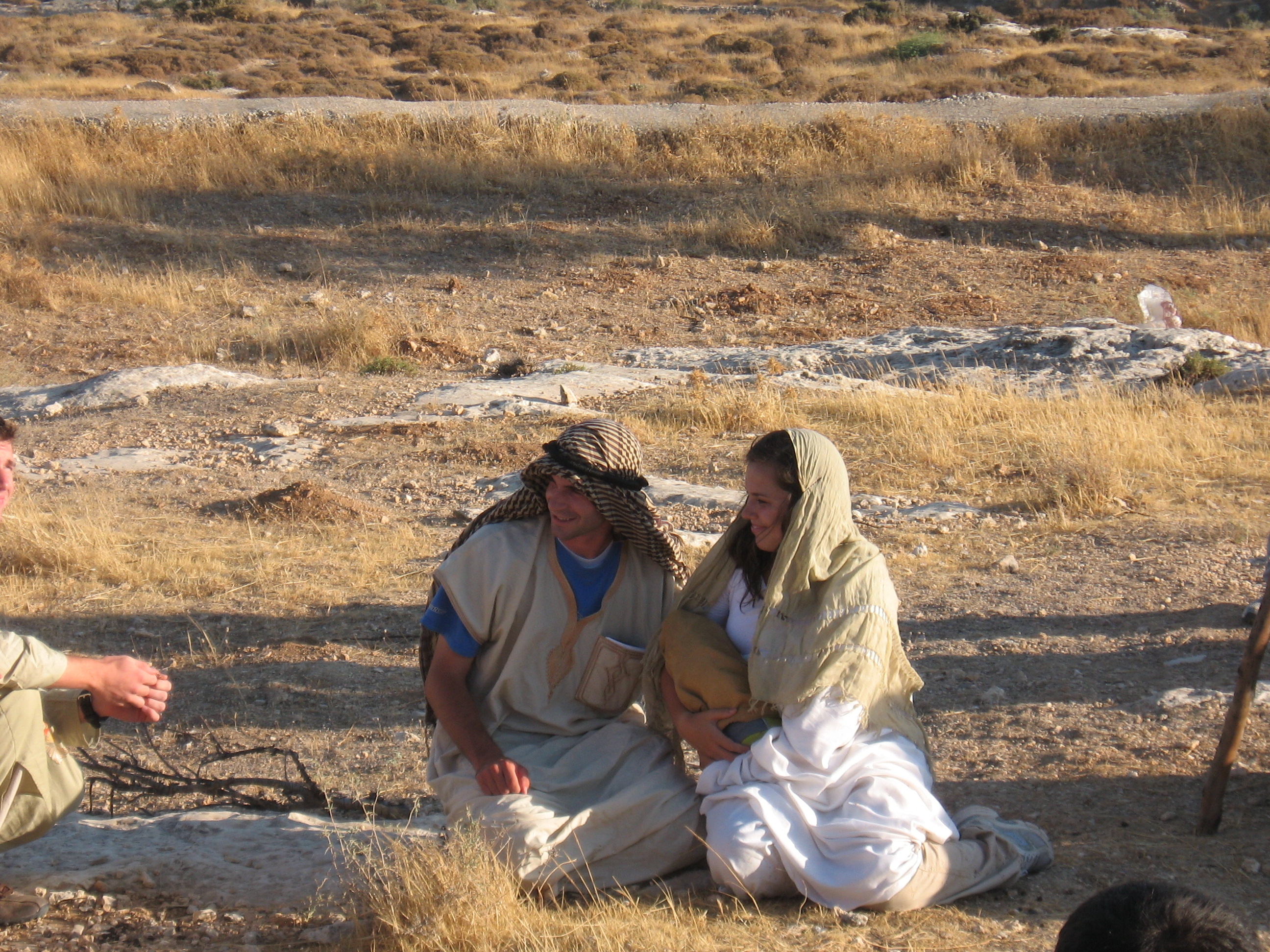
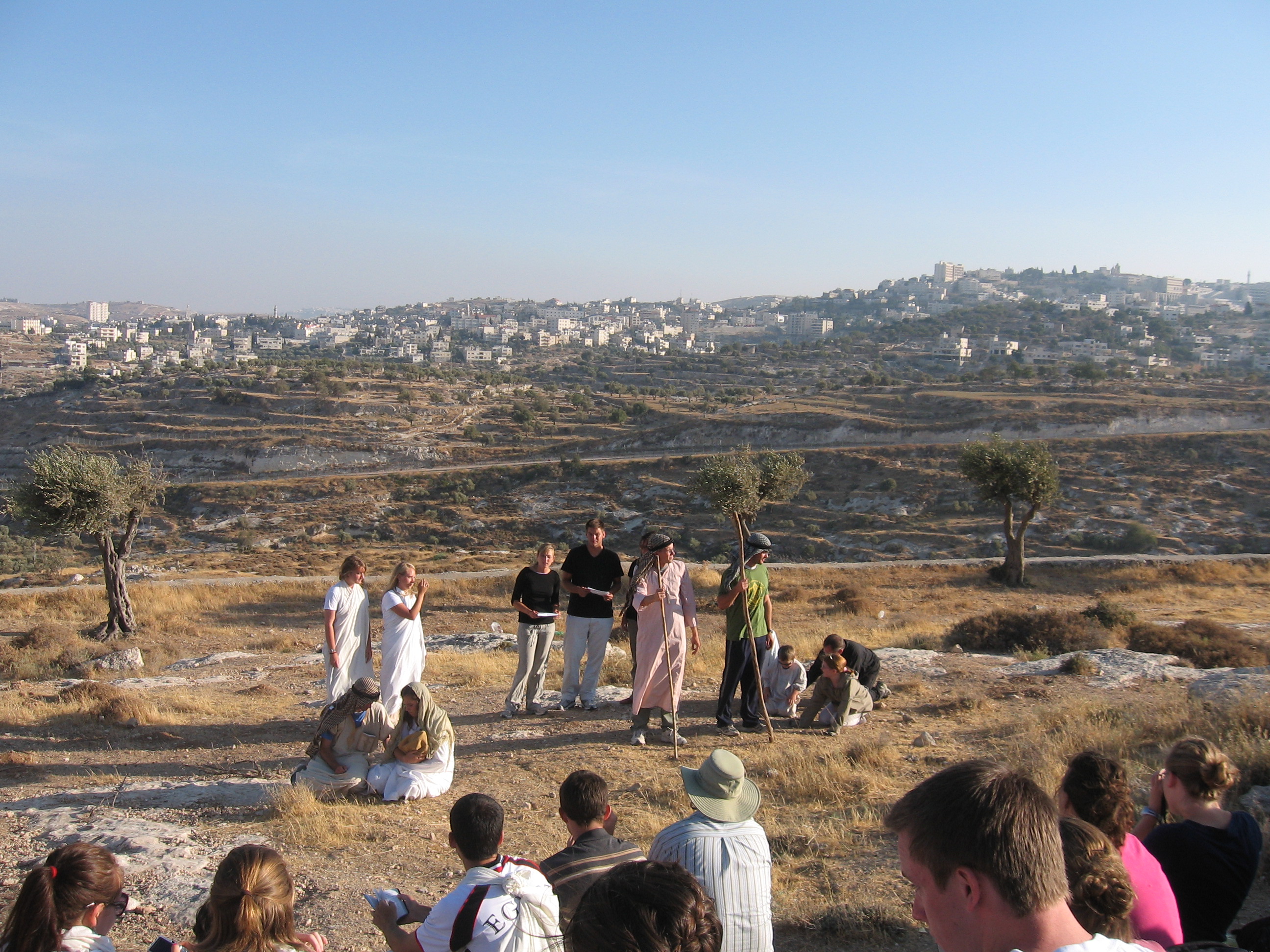
Exactly six months ago I was in Bethlehem. It was a fabulous experience. I went to the Church of the Nativity, built over a grotto where tradition holds that Mary gave birth to Jesus. I went to the fields where the shepherds were that followed the star. And I had the opportunity to gain new insights from my professor about the birth of Christ. I want to share some of those insights with you.

The average age at time of betrothal was 12 or 13 for a girl in that day, so Mary was probably about that age. Joseph would have been around 17 years old. What amazing faith in such a young couple!

our nativity, on shepherds' hills overlooking Bethlehem

Inns had a large courtyard for animals, a lower level for cargo, and an upper level for people. This made them ideal for caravans passing the night. There was no room for Mary and Joseph in the inn (upper level), so they may have stayed in the lower level with the cargo and animals or they may have been in a grotto underneath a home. (the Church of the Nativity is built over such a grotto. It was one of the three churches established by Helena, mother of Constantine, who was supposed to erect churches for the most holy sites of Christendom. She would ask around and find out where tradition had it that these events occurred. So even though the church was built around 300AD, it was an important enough event that tradition would have been strong, and the location is probably within a few hundred yards of the real one) However, the greek term used here could also mean “guest room.”


It was normal for young boys to stay with the flocks (recall young David), so the fact that there were older men there that night is significant. They would only have been there because it was the time of birthing. The shepherds were Levites who had been looking for the Savior their whole lives. The lambs being birthed that night were destined for temple sacrifices, being a type and shadow of the sacrifice that Jesus would make 33 years later. This is my favorite insight I picked up about the birth of Christ.

That night there were only shepherds, though—the wise men came later. They were probably Persians, and could be of the Zoroastrian religion. The Bible Dictionary says that they could see the star when others could not (!) and found the young child later on. The three gifts are symbolic:

Item: Use: Symbolism:

Gold Royalty Son of God

Frankincense Used in temples Priesthood

Myrrh Used in burials Coming death

The items were also quite valuable. We see from the sacrifice (a pair of turtledoves or two young pigeons) that Mary and Joseph brought at Jesus’ circumcision that they were quite poor. It is possible that the gold, frankincense, and myrrh were sold to finance the Holy family’s flight to Egypt. I love the way that God takes care of people’s material needs!

Anyway, I hope these insights and pictures help you to picture the Nativity this CHRISTmas season. I love being able to picture the spot in my mind, and I love knowing the deeper significance of certain things.

Thursday, December 9, 2010

The Beautiful Parodox of Love

My friend, Jenna Kimble, wrote a song, and one particular line caught my attention: "And each time I give away my heart, there's room for more love, whether to give or receive...room for more love."

It's amazing! You would think that you would have less capacity to love after giving away pieces of your heart...but somehow my ability to love is always replenished. Giving love away doesn't diminish it. Somehow it's always filled back up.

I have found this to be true in a variety of situations. For example, on my mission I never stayed any place very long: 6 weeks to 3 months tops. So I routinely gave my heart away to people, and then had to leave them. It was painful! But whenever I went to a new place, I was able to love them just as well. The old people still held a piece of my heart, but I still had a full heart to give to the new people. And since I've come back, I've been amazed at my ability to love people here, even though I felt that I'd left my heart in Brasil. Now I feel like I left half my heart in Jerusalem and half my heart in Brasil; yet I still have a full heart to give to my 28 students!

Somehow I've picked up the ideal that choosing to love is never a bad choice. I don't know if someone taught me that or if it was from a catchy quote, or what...but somehow it entered into my ideology. Choosing to love is never wrong. And in my stage of life, living by this adage can be painful! Sometimes I give my heart to someone and then they decide they don't want it, and it takes a while for me to regain ownership of my own heart. But when I do, I always find that there is room for more love: more love to give and more to receive. And I'm always better for it. Even though it hurts, I've never regretted loving somebody.

I wonder if this is part of our divine heritage. I was listening to President Uchtdorf's talk on love this morning on my way to work, and he was talking about how we inherited the ability to love from our Father, who is all-loving. I think this is part of the miracle of love: that no matter how much of it we give away, the supply is always replenished. There's room for more love.

p.s. Jenna's song is amazing, and it is available on i-tunes. It's called "Bring on the Rain."

Thursday, December 2, 2010

The Beginning of the Rest of My Life

I had an epiphany the other day that I want to attempt to put in the words.

You see, when I was a child, I was very me-centered. I feel like my focus/perspective gradually widened to include family and friends and maybe a little bit of the world as I grew up and went to school. Yet I was still quite self-centered. In college, as much as I would've liked to think that I wasn't, my focus was still on me. I got a brief taste of other-centeredness when I served as a missionary, and it felt like a breath of fresh air to not just be focused on me all the time.

Right now I'm entering a new phase of life--instead of studying, I have started my career as a school teacher! I spend probably 14 hours a day actively preparing to teach and teaching 28 ten and eleven year-olds. I'm constantly thinking about how to teach and help them. Even when I'm not at school, they're on my mind. At Thanksgiving, when I was "resting", I was thinking about them. When I can't sleep at night, my mind goes to them. Sometimes I wonder if it's unhealthy, but I'm constantly thinking about my "kids."

At times I feel overwhelmed/frustrated and want to have time for me. I expressed that feeling to my mom, who is also a school teacher. She said something to the effect of, "Well, Sabrina, just wait until you're a mother! It's going to be like this but more so." At the moment, that thought overwhelmed me even more, and I wondered if I would be able to do the whole motherhood thing. But I've been thinking about the concept ever since.

I wonder if life is a gradual opening of our perspective from self to others. I wonder if our experiences and progression from school to career to family is supposed to be a path to being other-centered. My career makes me think of others all the time, but I DO still have time to think about myself. But then I'm going to get married and have a husband to think about and care for...and then children! I could be selfish and think of this as a negative thing (indeed that is the message that the world is telling women), or I could have an eternal perspective and think of this as an exciting part of my progression--to becoming what I am supposed to become. It makes me think of the progression beyond the grave... my goal is to become as Heavenly Father and thus have infinite posterity. I will have tons of spirit children to be thinking about all the time. Does God think of himself very often? I think he spends all of his time being concerned with the eternal life of his children. It is an endless process of becoming less concerned with self and more concerned with others. And in losing ourselves, we will find ourselves. So I think that me being wrapped up with my 28 kiddos is the humble beginning of a long journey to being completely, happily other-centered.

Monday, November 15, 2010

R-E-S-P-E-C-T: find out what it means to me

I've been pondering about respect for YEARS! Like in my previous post, I realized that my family had something that that wasn't exactly common, so I wanted to figure out how it happened. The thing is, I'm the 5th kid of 6...so the atmosphere of my family was definitely already established before I was born. I didn't get to see how my parents started it, and I knew that I wanted to cultivate similar respect in my future family and wanted to understand how it was created. I thought about it, though, and I came up with a few things my parents did to establish an atmosphere of respect. Then I want to talk about another family's example of respect, and then finish with respect in my classroom.

Here are things my parents do that I think contributes to the high-respect level in my family:
1. They show respect for each other at all times (literally, I don't think I have ever seen them disrespect each other)
2. If they ever do/say something that hurts our feelings, they apologize to us (I don't know if you've ever had one of your parents apologize to you, but it's a humbling, gratifying experience that definitely built my respect for them)
3. They demand that we show respect for each of them. Pretty much the worst thing you could do in our family is disrespect one of our parents, in which case, the other parent would come and have a serious talk with you, and you would never want to do it ever again. At least, I didn't.
4. They each express appreciation for the other to us, when the other one isn't there. I can't count the times that Mom, when Dad wasn't there, told us how much she loves Dad and how grateful she is for everything he is and does. Dad does the same, talking about Mom to us. This is reassuring as a child, and it also built our respect for them.
5. It's just the unspoken expectation that everyone knows. I can't imagine back-talking my parents or speaking to them with an attitude; I really can't. It would be such a cultural faux-paux.

So figuring out those things helped me get an idea of how an atmosphere of respect was created, at least in one situation. Then I found another family that has a high amount of respect for each other. It's the family of one of my Relief Society ladies back home. She's 30-something and has 3 kids. And I was struck by how much respect she has for her kids! In turn, they respect her and each other, and the family has an easy, comfortable feel to it. I asked her about it once. She said that she shows her kids respect. I asked her how, and she said something that I consider to be profound. She said, "Mostly by listening to them." That's it! It seemed too simple, so I watched her, and I noticed that when her 2 year old daughter wanted her to see/watch something or listen to her, my friend gave her her full attention. She zoomed in on that baby when many mothers would be like "yeah, uh huh, that's cool." But even at that young age, she showed her baby the respect that if she (the baby) thought it was important, she (the mother) would esteem it as important. Kind of like a certain other Being I know and admire... :)

Finally I have had the opportunity to practice what I've learned. Three months ago I started teaching 5th grade. I thought a lot about the kind of atmosphere I wanted to create, and I had an idea of how to create it, but not really. So I did the best I could, and the first weeks were a whirlwind, and now I'm finally at a place where I have time to reflect. When I've been observed by the higher-ups, the first thing they always say is, "I like the feeling-tone in your classroom" or "I love the atmosphere you've created." Something to that effect. So I thought about it, and I think I've been largely successful in accomplishing what I wanted to in that area (I say this not to brag, but to figure out how it happened). My students respect me, I respect them, and they are generally kind to each other. Our classroom feels peaceful, calm, and relaxed. We work, we laugh, we play. It's just good. So I have been thinking about what I did that made it that way (and I believe that I am only responsible for half of this result...the other half came from the students themselves). Here's what I came up with:

1. Four out of our 5 class rules have to do with respect: Show RESPECT for yourself, Show RESPECT for your peers, Show RESPECT for your teacher, and Show RESPECT for the school.

2. I do my best to show respect for them. I pay attention to them when they talk, when I'm helping a child I am completely focused on him/her, I try not to call them out or embarrass them, and I respect their ideas. I try really hard to incorporate democracy into our classroom, letting them voice their ideas and concerns and then voting on what we should do about them. They know that I care about their ideas. For example, although I presented the class rules, they came up with the consequences themselves. At least once a week, a student will bring something up and we will vote on it as a class. It is not a dictatorship. I try be authoritative but not authoritarian. They have say in how our classroom runs.

3. I require them to show respect to each other. If a student is making a comment and others are talking at the same time, I tell the student to wait until his classmates are showing him respect. And I use the word respect. I try to encourage kindness by keeping a bucket where students write the kindnesses that their peers are showing them, and we read the papers aloud at our class meetings.

4. If we have an issue, we discuss it. The other week I was noticing a few hurtful comments being exchanged by members of our class, and I brought it up at our class meeting. We discussed it and resolved to do better.

5. My students know that what makes me most proud is to hear that my students are kind and respectful when I'm not there; what makes me most disappointed is when they are disrespectful.


So I feel like I'm more prepared to create an atmosphere of respect in my future family, recognizing the contributing factors in the three situations above. And I think that the bottom line is this: to get respect you have to show it.

What do you think? Are there other factors that you've noticed? How do YOU establish respect?

The Supreme Importance of "Thank You"

I don't consider myself to be a very observant person, but I have observed something about the importance of saying "thank you" in relationships.

I started observing this as a teenager. I noticed that my parents say "thank you" to each other ALL the time! Dad says "thank you" for dinner. Mom says "thank you" when Dad takes care of the yard. They don't just say thank you for the unusual, extraordinary things--they express gratitude for the other person simply doing what's expected of them! Just the ordinary, everyday responsibilities! And they don't just thank each other, they thank us, too. And you know what? When someone tells me thank you for fulfilling my normal responsibilities, it makes me want to keep doing them. It makes me want to do them better, and it makes me happier while I'm doing them. Another funny thing is, my parents "help" each other notice things they should thank each other for. "Did you notice that I waxed the floor?" Dad asks Mom, who immediately thanks him not only for waxing the floor but also for helping her notice! It's kind of ridiculous in one sense, but in another I think it shows something simple and beautiful about their relationship--they trust that the other person would want to express gratitude, and instead of being upset that he/she didn't notice, they help each other out by saying something.

So in high school I started noticing how cool/unusual it was that my parents say "thank you" all the time...and then I started seeing relationships where that wasn't the case. I saw other marriages, friendships, relationships, and families that hardly ever say thank you...even when it would normally be expected. And I noticed a huge difference. There was more tension, dissatisfaction, and conflict. Of course, I realize that there could be a zillion other factors, but I think that frequency of saying "thank you" (sincerely) is a huge indicator of success in relationships. It is something that I plan on doing. Often.

Thanks for reading. :)

Sunday, November 14, 2010

How the Atonement Heals Emotional Wounds, Part II

So every once in a while I like to reread my old blog posts. Especially the ones from before my mission, because I had these epiphanies back then and sometimes I forget that I even had them. So it's good to remember. And the other day I saw my old post about how the Atonement of Jesus Christ heals emotional wounds, which was really a new concept to me at the time, because I mostly thought about the Atonement in the context of paying the price of sin. I have learned much since then.

Two weeks ago, one of the apostles, Elder Hales, came and spoke to us. He touched on a variety of subjects, but one of the stories he told stood out to me. He told about a young man he knew that came to see him. The young man had just broken up with his girlfriend or fiance, and was pretty depressed. He thought his life was horrible. Elder Hales had just spoken with several people before him that had much worse situations, but he listened to this young man for an hour, sympathetically. Then he told me to get on his knees and tell Heavenly Father everything he was grateful for. "Take an hour or two! However long it takes!" he told him, "until you are filled with His love and your pain is gone." What a remarkable concept is revealed in that advice! Recognizing what Heavenly Father has done/is doing in our lives opens us up to feel His love for us, and allows the Atonement to take our pain away! I've always loved the quote in Preach My Gospel about how the Atonement heals anything that is "unfair" in our lives, and I think this shows a little of HOW that happens. I love the universal applications of the Atonement! I am so glad that there is a way to become whole and be healed. I love Jesus Christ, and I'm grateful for the effects of His Atonement in my life.

Wednesday, October 27, 2010

Collaborative Blog

Hello readers!
I want to let you know that I joined a collaborative blog along with some friends, and I will be posting there monthly, if you want to check it out. The blog is entitled "The Gem Seekers," as we will be trying to find the good and the beautiful in life. Each of us has a (generally gemstone themed) pen name. Since Obsidian was taken, I decided to be Graphite. Yes, I know it's not exactly a gemstone, but it is a mineral! And more importantly, it is what we use as lead in pencils, and that's how I feel about my musings/opinions--they're written in pencil, subject to change with new information.

Anyway, I made my first posting last night, under the title "First Comes Gratitude, Then Comes Love." It's basically my thinking and experiences with President Monson's latest talk, in which he told us that gratitude is the parent of all other virtues. Check it out!

Sunday, October 17, 2010

A Profound Summer

Hello Friends and Family!
I'm sorry it has been forever since I have written. Over the summer I abandoned this blog in favor of my Jerusalem one. As I start this blog back up, I want to briefly summarize in what ways it was a profound summer for me.

On one of our last nights in Jerusalem, we had a spiritual fireside. Probably 6-8 people were asked to give a 5 minute talk on how they got closer to Christ during this experience. I was one of those people. I was asked several days ahead of time and had some time to ponder the question. This is what I thought about.

When I was praying to decide if I should apply for the Jerusalem study abroad, I had a distinct impression and experience that told me that Christ wanted me to go because He wanted me to learn of Him. I applied, was accepted, and from Day 1 knew that that was my purpose: to come to know Christ better.

I feel like my understanding of Jesus Christ has become more three-dimensional--it has widened and deepened. I understand the context of His life--the land, the people, the culture, the circumstances politically and religiously. I have studied his teachings more, and was especially touched by the Sermon on the Mount. I started putting those teachings in practice in small ways. I gained a greater appreciation for Christ's character, especially his obedience to the Father and his concern for others that was/is greater than his concern for self. I gained more respect for Him as my God. I came to better understand the Atonement He performed, including its cleansing power AND its enabling power. The cleansing power makes bad men good, and the enabling power makes good men better--enables them to develop Christ's attributes and become perfect. I experienced His enabling power this semester. It helped me to forgive someone when it was difficult for me of myself to do so, and it was a beautiful experience that helped me see God's mercy and love. He is enabling me, little by little, to do and be what He asks. I feel that out of my experiences this summer I have gained greater conviction in and dedication to my beliefs. It's more real to me.


Furthermore, I pondered on why and how I felt the Spirit of God during this semester, and I had an epiphany. It's simple really, and I had already heard it many times, but I "discovered" it anew, and it entered into my heart. Remembering Jesus is what encourages the Spirit to be with us always. THAT is why I felt to Spirit so much this semester--I was remembering Him everywhere I looked. I thought of Him many, many times during the day. And that is something we do not have to be in Jerusalem to do. ...which was a comforting thought to me as I was about to leave Jerusalem. I can remember Jesus anywhere.

In the two months since returning from Jerusalem, I have found a few geographic reminders of the Holy Land right here in Utah, that help me to remember Jesus more often. Utah Lake reminds me of Galilee. Mount Nebo is named after the Mount Nebo in Jordan, where Moses first saw the Holy Land and where Elijah was taken up into heaven. Right next to Mount Nebo is a foothill that is shaped like the Mount of Transfiguration. On my drive home from school there is a slope that reminds me of the Mount of Beatitudes. Such things help me as I strive to keep the Spirit with me always, and remember what Jesus has done.

Wednesday, March 31, 2010

Isn't It Extraordinary?

When I was younger, I never thought to question the status quo. Things that were "normal" were that way because they should be. I took them for granted. Now that I am older, I find myself looking at these "normal" things in a different light. I analyze them and make my own judgments about them. One of these "normal" things is family--both marriage and having children.

Look at the institution of marriage! I truly think it is extraordinary. A person pledges to another that he/she will cherish, love, honor, and take care of the other for time and (in my personal beliefs) all eternity. How selfless is that? It is amazing! Dedicating one's life to another person. It's beautiful. It's Christlike. I love the concept of charity in marriage--you don't have to worry about yourself, because you know the other will take care of you; you can concentrate your efforts on the well-being of the other. It works because the other person is doing the same. It is a complete reciprocal relationship (this, of course, is speaking of marriage in its true and intended form, which is not necessarily how it is always carried out). The late Prophet Gordon B. Hinckley of The Church of Jesus Christ of Latter-Day Saints spoke via satellite broadcast to the members in southern California in the month before he died. He spoke on marriage. He said that each spouse should be "anxiously concerned for the well-being" of the other. I love that! Anxiously concerned for their well-being! What could be more beautiful than a selfless marriage?

I am also impressed by the completely altruistic decision many people make to have children. In agrarian societies, having children would be of economic gain. In our modern society, they are a liability. The conscious decision to procreate, I believe, is selfless and beautiful. What's more beautiful is the parents' decisions to have lifestyles that continually support the nurturing and growth of children. Parents dedicate 20-30+ to the support of their children, putting aside personal interests and luxuries.

Granted, several marriages and families are not formed according to these ideals. However, the current trends in society do not define the institution. And the institution of marriage and family is most noble. Though I took it for granted in my youth, I appreciate it now. Isn't it extraordinary?

Sunday, March 14, 2010

Routines, Rituals, Storytelling, and Humor

Last weekend when I was at the Stand for the Family Symposium, I talked with this lady about her paper, "The Ties That Bind." Her idea was that there are four things that keep families together: Routines, Rituals, Storytelling, and Humor. I was especially interested in this, because I just wrote a book on family traditions (routines and rituals!); so I kept listening.

She then told me how she has kept on believing in the family, despite all of her various families falling apart. I asked her how she kept believing, and she said that it was because of her belief in the Church. She then proceeded to explain that what kept her in the Church are those same four things: (these are her own words)

1) Routines: Daily taking advantage of prayer and scriptures; using fast, tithes and offerings, repentance, journal writing, and service regularly in my life.
2) Rituals: Honoring and partaking in the rituals of sacrament, temple worship, and prayer on a regular basis doing all that I could even when I slipped or "tottered"; even when I fell I maintained the principles and practices to the best of my ability. (of special importance to note is that when I was unworthy of receiving the blessings of the temple garments after speaking with Bishop I continued to wear them to tell Father and myself that I desired to be worthy and that I respected the covenant I had made even though I had fallen short of it)
3) Storytelling: Scripture reading and journal writing have been a significant part of my journey. I simply could not be where I am today if I had not partaken in these practices on a regular basis since my baptism at age 27 some 21 years ago. This I liken to the "storytelling" that binds the hearts and minds of us on earth to those who we left on the other side of the veil and connecting us to those yet to come. This of course leads ones heart to a significant remembrance of those who have gone before us and the genealogy work that must be done for them.
4) Humor: Humor might seem like the least of these components but to me it is a vital ingredient without which the rest do not come together. Humor, to me, is basically not taking yourself too seriously. It is looking for the joy and fun in all things; I believe it truly is there to be found, we just have to train ourselves to look for it. What an adventure, what a delight, it certainly does not allow things to become boring that way.


I found that idea profound. I believe it extends to any group of people that you would like to be bonded together. I am thinking about using these four things in my classroom when I am a teacher, to create a united class. When I create my own family, I will use these four principles to keep us strong.

Sunday, February 28, 2010

The Purpose of Teaching

I'm studying to become a teacher, so I tend to think a lot about teaching. Lately I've been pondering on the purpose of public education in a democracy, and the purpose of teaching in general. I want to discuss the latter.

Knowledge is power, right? But why? Because knowledge increases one's ability to make choices (hence defined as agency--one's personal ability to choose for oneself). I see this illustrated in my own life all the time. For example, finding out that there is a concert on Wednesday gives me the ability to then choose if I will go to it or not; but first I need the knowledge of it. The more knowledge you have, the more choices you can make, the more full your life is--for you are actively creating it.

So if the function of teaching is to impart knowledge (or "construct" it, depending on the behavioral theory you subscribe to), then the purpose of teaching is to increase your students' ability to choose. That is the "why" of education. We teach so that students can have the necessary skills and knowledge to actively create their own lives. Hopefully we do so in a way that also imparts values of responsibility, accountability, and character. Hopefully our students use their agency for good. But our purpose is to give them the tools.

I came up with this little theory a few weeks ago, and recently found support for it from the apostles and general authorities of The Church of Jesus Christ of Latter-day Saints. In a Power of Teaching lecture at the BYU school of education, President Russell G. Osguthorpe of the General Sunday School Presidency stated the purposes of teaching to be "(1) To increase one’s power to exercise personal agency, and (2) To increase one’s capacity to love." Elder David A. Bednar of the Quorum of the Twelve Apostles expounded upon the role of agency in teaching and learning in a recent address. The whole talk is wonderful, and has interesting implications for teaching.

For myself, the implications of what I have discovered are simple: I am teaching students, not lessons. The material is important only insomuch as it expands the world of the students. Teaching them how to learn and to take responsibility for their own learning will be one of my primary focuses. I want to inspire and enable my students to be active in deciding their own lives, rather than being acted upon.

Making a Stand

For those of you that don't know, I self-published a book recently. It is a compilation of family traditions that is intended as a resource for families--similar to a baby name book--you browse through it and pick traditions that sound fun to implement in your family.

Anyway, I started this book several years ago, but got discouraged with the project. When my friend told me about the Stand for the Family Symposium, I decided to write a proposal about my book for it. And they accepted it--so I had to finish my book.

It never occurred to me that by participating in the symposium I would be making a stand. I honestly did not know when I applied to the symposium that its main purpose is to promote the preservation of the traditional family with the traditional definition of marriage. My book's appearance in this symposium shows support for that political view. (I personally espouse that political view, so that is ok with me)

I realized that when I read the following message from a friend. I spammed all of my friends, asking them to share their traditions with me so I could finish the book. This was her reply:

Dear Sabrina
While I wish you the best of luck in pursuing your passions and participating fully in this conference, I cannot offer my family traditions to, or support, the Stand for the Family Symposium.
Respectfully,
*name has been omitted

I read that and was struck. At first I had no idea what would cause her to not support the symposium. Then I realized that defining marriage as only between a man and a woman goes against her personal beliefs about government, and that the symposium therefore would oppose her viewpoint. And when I made that connection, I was impressed. She could have ignored my message and not replied. After all, I wasn't even writing to her personally--it was a group message. She could have shared her family traditions with me (or ignored my message) without going to the symposium's website to find out what it was about. But that's not what she did. She did a little research to find out the symposium's position, and then, instead of remaining quiet and passive, she wrote me back. And she did so in the most respectful way possible. In fact, she didn't even say why she could not offer her support to the symposium--I figured that out myself. But she raised her voice and let her lack of support known. She made a stand.

How many times could I have made a similar stand on something I believe in, but chose to say nothing? I am filled with respect and admiration for my friend's activeness and integrity in supporting what she believes. I feel inspired to do the same. When something goes against my personal values, I want to say something, and let my lack of support known. Similarly, I want to show my support to causes and projects and laws whose values I agree with.

Monday, February 8, 2010

The Problem with Shining

We're supposed to let our light shine, right? Interestingly enough, "it is our light, not our darkness that most frightens us." --Marianne Williamson That phrase seems counter intuitive. Everyone wants to be great, so why would it be our light that scares us? In talking with my roommate, I've decided that it's not necessarily our light that we fear--it's other people's reactions to our light.

What happens when we shine? (shining=showing forth our strengths and talents instead of hiding them, and hopefully doing so for altruistic purposes) When we shine, people are made aware of their own darkness, and react in one of two ways:**

1) they withdraw from us. They are made uncomfortable and insecure by our light, and instead of rising up, they retreat from us into the comfortable cushion of undisturbed mediocrity. This is a common reaction. This is what we fear.

2) they will be drawn to us. They are inspired by us and feel liberated to also shine. They are freed from the familiar ties of mediocrity, and reach up toward their potential.

There really isn't a middle ground. When you shine, people will either come or leave. And that is scary. It is scary to go to that point where one of two things will happen, and you can't have both anymore. In fact, because of that fear, we often wallow in indecision and lose both. Risk-taking is essential to success. And that is why our light scares us. Pretty ridiculous if you think about it. Understandable, but ridiculous. What have we got to lose, anyway, right?

After all, we are all children of God, the Being who shines for all to see. If we're growing to become "perfect even as He is perfect," then we ought to lose our fear, and shine.


**I think it is also important to note that others' reactions will be greatly influenced by our own approach to shining. Egotism makes people withdraw. Sincerity and goodwill draw people in. Yet the other determinant in this situation is the character of the other person, and you can't control that. How they react is their choice. You, however, can determine your own intentions and approach to shining.